The Olive Grove
For many years I have worked as a regenerative farmer in the Parc Natural dels Ports. Agriculture is still my main source of income and has taught me more about nature than any book, university or artistic practice ever could. At the same time, some of the most disconnected people I have met from the living world have also come from agricultural backgrounds. That contradiction has stayed with me for years.
Over time I began to feel a certain frustration. Many of the questions that matter most to me seem difficult to explore through agriculture alone. Even regenerative agriculture often remains strongly shaped by an anthropocentric perspective. Production, efficiency, yields and management continue to occupy the centre of attention. There is rarely much space for uncertainty, play, wonder, or for asking questions that have no immediate practical value.
Yet those questions have become increasingly important to me.
What is our ecosystemic function as human beings? Why have we become so disconnected from the living world? Why do so many of us walk through landscapes without being moved by their colours, fragrances, textures or fruits? Can we become part of nature again? Is it possible to fall in love with life itself?
This project emerges from that kind of questions.
Through the freedom that art provides, I am exploring what I call regenerative land art: a practice that uses ecological regeneration not only as an environmental goal, but also as a medium for investigation.
Nature itself becomes both studio and artwork. Trees, shrubs, groundcovers, wildlife and human participation become part of the same composition. The intention is not simply to restore biodiversity or improve production, although those outcomes may emerge as a consequence of the process. The deeper intention is to explore new ways of feeling and experiencing our relationship with the living world.
Rather than creating representations of nature, I am interested in participating within it.
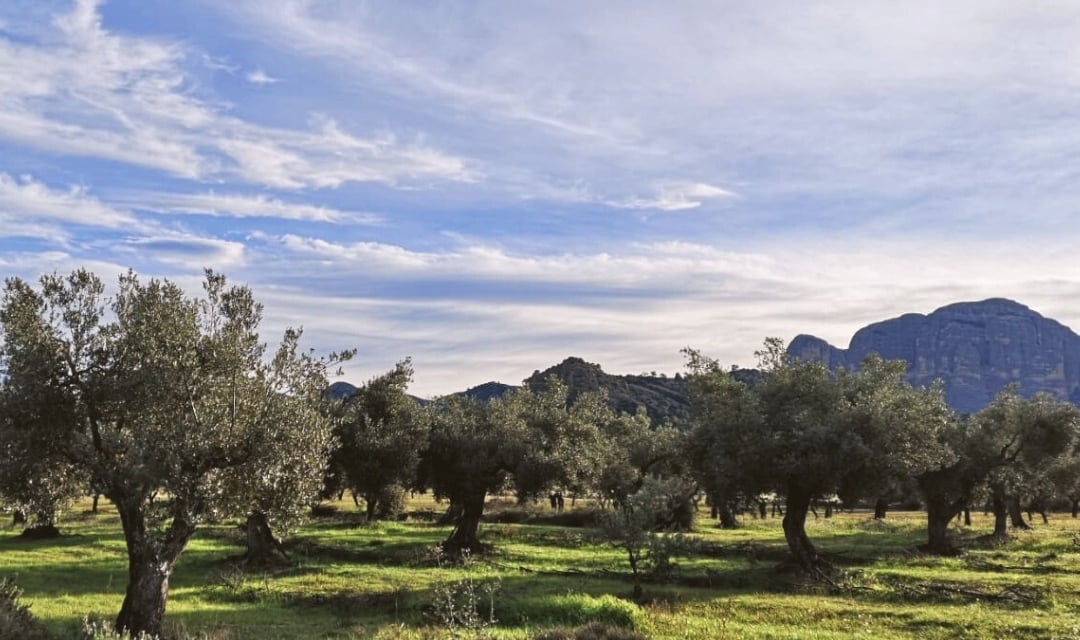
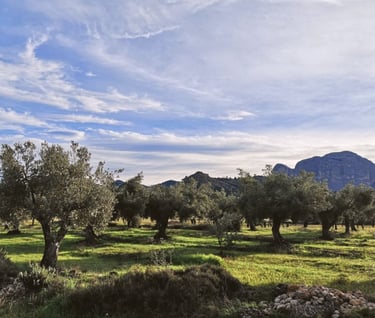
The different pieces created through Enaturarte help support this process. The piece you acquire becomes part of the gradual transformation of a traditional dryland olive grove into a living experiment in regenerative agroforestry, ecological complexity and artistic practice.
I do not know where this investigation will lead. There is no final destination, no predefined result to achieve. If there is a purpose, it is simply to remain in relationship with these questions and to see whether a deeper sense of belonging to the living world can emerge through the process itself.
Perhaps that uncertainty is precisely what makes it worth pursuing.
El Olivar
Durante muchos años he trabajado como agricultor regenerativo en el Parc Natural dels Ports. La agricultura sigue siendo mi principal fuente de ingresos y me ha enseñado más sobre la naturaleza que cualquier libro, universidad o práctica artística. Al mismo tiempo, algunas de las personas más desconectadas del mundo vivo que he conocido también procedían del ámbito agrícola. Esa contradicción me ha acompañado durante años.
Con el tiempo empecé a sentir una cierta frustración. Muchas de las preguntas que más me importan parecen difíciles de explorar únicamente a través de la agricultura. Incluso la agricultura regenerativa sigue estando, a menudo, profundamente condicionada por una mirada antropocéntrica. La producción, la eficiencia, los rendimientos y la gestión continúan ocupando el centro de atención. Rara vez queda espacio para la incertidumbre, el juego, el asombro o para formular preguntas que no tengan una utilidad práctica inmediata.
Sin embargo, esas preguntas se han vuelto cada vez más importantes para mí.
¿Cuál es nuestra función ecosistémica como seres humanos? ¿Por qué nos hemos desconectado tanto del mundo vivo? ¿Por qué tantas personas atraviesan paisajes sin sentirse conmovidas por sus colores, fragancias, texturas o frutos? ¿Podemos volver a formar parte de la naturaleza? ¿Es posible enamorarse de nuevo de la propia vida?
Este proyecto nace de la practica repetida de ese tipo preguntas.
A través de la libertad que ofrece el arte, estoy explorando lo que llamo land art regenerativo: una práctica que utiliza la regeneración ecológica no solo como un objetivo ambiental, sino también como un medio de investigación estetica y relacional.
La propia naturaleza se convierte tanto en estudio como en obra. Árboles, arbustos, cubiertas vegetales, fauna y participación humana pasan a formar parte de una misma composición. La intención no es simplemente restaurar la biodiversidad o mejorar la producción, aunque esos resultados puedan surgir como consecuencia del proceso. La intención más profunda es explorar nuevas formas de sentir y experimentar nuestra relación con el mundo vivo.
Más que crear representaciones de la naturaleza, me interesa participar en ella.
Las distintas piezas creadas a través de Enaturarte ayudan a sostener este proceso. La pieza que adquieres pasa a formar parte de la transformación gradual de un olivar tradicional de secano en un experimento vivo de agroforestería regenerativa y práctica artística.
No sé adónde conducirá esta investigación. No existe un destino final ni un resultado predeterminado que alcanzar. Si hay un propósito, es simplemente permanecer en relación con estas preguntas y observar si, a través del propio proceso, puede emerger un sentido más profundo de pertenencia al mundo vivo.
Quizá sea esa incertidumbre lo que hace que merezca la pena seguir por este camino.